Mines Nancy computer science researcher Xavier Goaoc has been named a senior member of the Institut Universitaire de France (IUF), recognizing two decades of work in algorithmic geometry.
Every year, the Institut Universitaire de France (IUF) honors 200 researchers and professors — 100 junior and 100 senior fellows — for the excellence of their work and its capacity to push the boundaries of knowledge. Starting October 1, 2026, Xavier Goaoc, a researcher in the Computer Science Department at Mines Nancy and a member of the Gamble team (Loria-Inria), will join the IUF as a senior fundamental research chair. The appointment recognizes his work in algorithmic geometry, a branch of theoretical computer science concerned with how computers process geometric information. We spoke with a researcher who has spent more than twenty years uncovering the hidden laws of geometric computation.
A Distinction That Rewards Fundamental Research
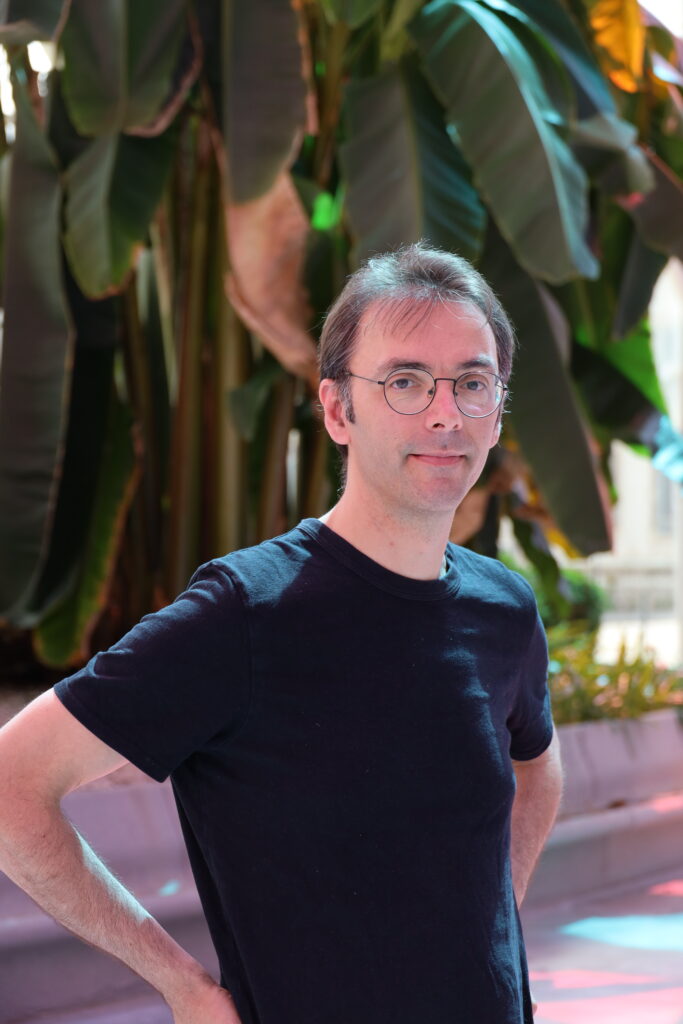
Xavier Goaoc, researcher in the Computer Science Department at Mines Nancy and member of the Gamble team (Loria-Inria), appointed to the Institut Universitaire de France
The Institut Universitaire de France is not an institution in the traditional sense, but a “label.” Each year it selects researchers across all disciplines — from the exact sciences to the humanities — whose research projects stand out for their originality and rigor. Being appointed to the IUF means joining a select circle recognized well beyond one’s own discipline: a recognition Xavier Goaoc describes, with a touch of humor, as a “sesame” — particularly useful when work praised at a computer science conference remains, by its very nature, hard for colleagues from other scientific backgrounds to evaluate or grasp.
Concretely, an IUF appointment brings three benefits: a two-thirds reduction in teaching load for five years, €15,000 per year in research funding, and automatic eligibility for the scientific excellence bonus. And finally, a form of recognition that — while not the goal in itself — opens the door more easily to new collaborations. “The real issue is time,” Goaoc emphasizes. Time that is all the more precious as it follows four years spent leading the Computer Science Department at Mines Nancy, a role he is now handing over to Guillaume Bonfante.
Understanding the Laws of Geometric Computation
Xavier Goaoc’s research focuses on algorithmic geometry (also known as computational geometry), a branch of theoretical computer science that studies how a computer — which only manipulates zeros and ones — can process geometric information. Doing so requires “discretizing” that information: moving from data that is, in principle, infinite (such as the exact coordinates of a point) to a “finite” form of information a machine can actually handle.
Take a concrete example: a geolocation system trying to determine which triangle of a vast mesh contains a given point. Rather than testing every triangle one by one, the computer proceeds through a series of very simple questions: is this point “above” or “below” a given line? By chaining these answers together, it progressively eliminates the triangles where the point cannot be, until it identifies the right one. That is discretization in action: replacing precise coordinates — theoretically infinite information — with a simple sequence of “above/below” answers that a machine can work with far more easily.
Understanding how these sequences of “above/below” answers behave, and how they can be tested or relied upon, sits at the heart of Xavier Goaoc’s research. In 2020, together with Emo Welzl (then at ETH Zürich), he proved that randomly placed points produce configurations that are indeed random — but strongly biased. In other words, testing a geometric algorithm on random data only explores a tiny fraction of possible cases. The result touches on complexity theory and calls for caution among anyone evaluating a geometric algorithm this way.
His research path has also taken him into the geometry of lines, with work on the mathematical modeling of imaging systems that generalize the “pinhole camera” principle, and more recently into the foundations of topological data analysis — an inference method that uses how geometric shapes overlap to reveal the hidden structure of large datasets.
Artificial intelligence is not unrelated to this field: in late May, a system developed by OpenAI advanced a problem that had remained open for nearly ninety years — the “unit distances” problem posed by mathematician Paul Erdős. “My field of research is also seeing the effects of AI progress, and this IUF fellowship will be an opportunity to explore what these new tools can offer,” Goaoc notes — even though this direction is not, strictly speaking, part of the research project he submitted to the IUF.
Research and Teaching: A Shared Standard of Rigor
A researcher recognized both in France and internationally — he had already received a junior IUF fellowship at Université Paris-Est before joining Nancy in 2018 — Xavier Goaoc sees his research as directly feeding into his teaching. At Mines Nancy, where engineering students follow a general curriculum with limited time for any single discipline, he has deliberately chosen to move away from existing textbooks in favor of his own pedagogical approach, grounded in his research practice: “Doing research at this level also means stepping back to reconsider methods, and what, among the things we know, truly deserves to be passed on,” he explains.
This close link between research and teaching also benefits the Computer Science Department more broadly, and its students — many of whom build custom academic paths that go beyond what the school offers on its own. The visibility gained through faculty research helps open doors at partner universities and laboratories for Mines Nancy students.
As for the department leadership role he is stepping down from as his appointment begins, Xavier Goaoc sees it less as a constraint than a natural part of the job: in a school where teaching, research, and governance largely rest on the same people, taking on collective responsibilities is, for him, simply “part of the deal.” A conviction that, in its own way, reflects what this IUF appointment means to him: less a crowning achievement than a chance to breathe — five years ahead to refocus his energy on the questions that, as he puts it plainly, “leave me puzzled,” and that he is eager to study and understand more deeply. To be continued…
Xavier Goaoc’s appointment to the Institut Universitaire de France takes effect on October 1, 2026. Congratulations to him and to the entire Computer Science Department at Mines Nancy.